From purity culture to embracing imperfection: An interview with author Anna Rollins
“Purity culture” is on the tip of the zeitgeist’s tongue, but it’s far from new. The idea that the body must be pure in order to be worthy is a feature of many religions, dating back thousands of years.
Fast-forward to today, where the Venn diagram of purity culture and diet culture reveals more overlap than separate circles.
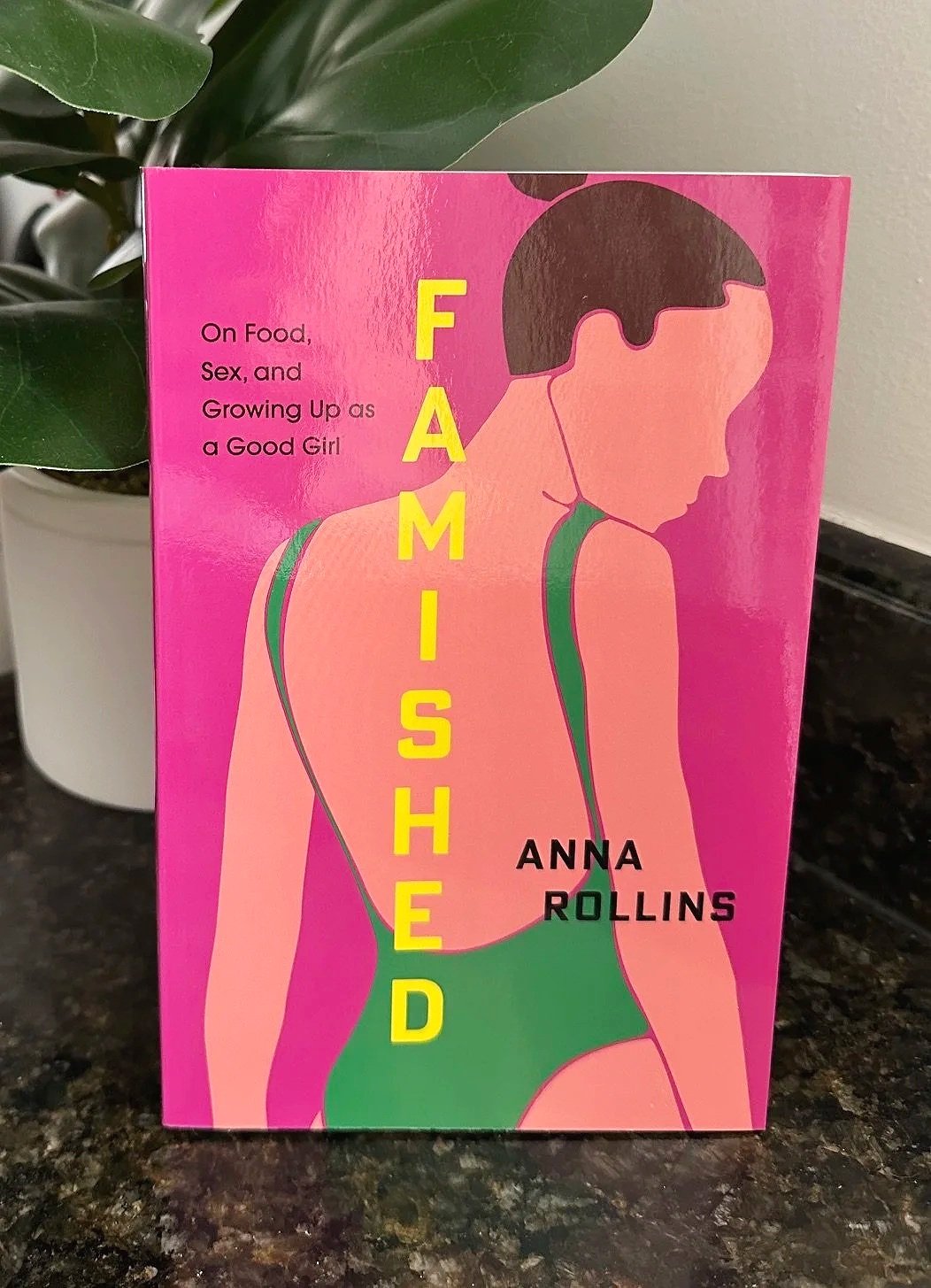
In her memoir, Famished: On Food, Sex, and Growing Up as a Good Girl, Anna Rollins writes about being raised in evangelical purity culture and learning that keeping herself small (in every sense of the word) would bring her closer to God. As she grew up, this endeavor became swept up by diet culture.
After reading her emotional story, I wanted to know more. Anna was kind enough to allow me to interview her about her experience. Our conversation is below.
Allie: Early in the book, you write about growing up with the sense that your body was something to control, hide, or discipline. What were some of the earliest messages that taught you to distrust your own hunger and desires?
Anna: I was receiving messages that I needed to distrust my own hunger and desires from both purity culture and diet culture.
Coming of age at the height of evangelical purity culture, which emerged as a reaction to the AIDS crisis, it pushed abstinence-only education in schools, and there was messaging that rooted sex in fear and shame because sex had become associated with disease and death. The backlash to the AIDS crisis was this idea that, because sex could potentially be dangerous, you should simply abstain.
At the same time, this was also the height of diet culture, when the slogan "Nothing tastes as good as skinny feels" was center stage.
There was also a broader war on obesity. Parents were afraid that the processed foods their children were eating, combined with too much television and too little movement, were contributing to an explosion in body sizes. Bodies came to be viewed as unruly and in need of tight control.
Those messages layered on top of one another profoundly shaped the way Millennials related to their own appetites and desires.
Allie: One of the more striking points of the book is that purity culture and diet culture share a similar logic. When did you start to notice that those two worlds were reinforcing each other in your life?
Anna: I think I noticed the overlap when I looked back at the content of my journals. As a teenage girl, I wrote about two basic things: my crushes and my desire for my future husband. In purity culture, girls were encouraged to think in terms of keeping themselves pure for their future husbands, and that was something I wrote about often in my journal.
I also wrote about dieting. I kept lists of the calorie counts of everything I'd eaten in a day. I wrote about my dieting plans and my desire to restrict so that I could achieve this idealized body, which, for me, translated into a kind of fairy-tale life. The content in my journals seemed strikingly similar. Both reflected the idea that restriction or abstinence would ultimately yield a fairy tale, whether in the form of the perfect body or the perfect marriage.
Because I was always a voracious reader, I found myself reading books about women's bodies and desire. I read feminist writers, and I began to see the connection between the way we feel about food and the way we feel about sex. Those two things often have significant overlap.
“I think I realized this was about much more than just health and faith when my desire for control began yielding the opposite of health and faith.”
Allie: You write about restriction becoming so ingrained that it almost felt natural. When did you start to realize that control was becoming more about just health or faith, but that it was tied to survival, identity, or power?
Anna: I think I realized this was about much more than just health and faith when my desire for control began yielding the opposite of health and faith.
I noticed it most clearly in parenthood. When I was faced with really difficult situations regarding my son's health, I leaned on restrictive behaviors that neither enhanced my health nor my son's. Instead, they gave me a false sense of security in a situation that felt completely out of my control.
When I found myself prioritizing my exercise regimen over my ability to care for my child in the hospital, I realized I was living counter to my actual values. That was the moment I saw how these behaviors were functioning in my life—not as something that was enhancing it, but as something that was constricting it.
“In some ways, disordered eating is a form of rebellion.”
Allie: Your story shows how secrecy can keep disordered eating alive, especially when behaviors seem “mild enough to evade diagnosis.” How did secrecy support your behaviors?
Anna: I think the secrecy was the fun of it. In some ways, disordered eating, for me and for many other women, is a form of rebellion. It's a way to do something wrong, but it can still be perceived as good. You can rebel while still, quote unquote, following the rules and not deviating from what's expected of you. It felt like getting away with something.
By bringing these things into the light, I took away some of the fun of the game. It took away some of the shame, but it also took away some of the thrill. And that allowed the obsessive-compulsive cycle to gradually wear off.
Allie: Even while you kept your behaviors hidden, there’s also a sense that part of you wanted to be seen. Can you explain more about the tension between wanting recognition for your struggle and worrying about what people might think if they knew the truth?
Anna: I think that, deep down, all of us long to be seen. But, of course, we're afraid of what others will see. We know that we're imperfect, and anything we struggle with reveals our humanity—which also means it reveals our imperfections.
I think all of us long to be seen through eyes of love rather than judgment. But being seen in that way isn't guaranteed when we reveal our struggles. So we're always navigating that tension: wanting to be known and accepted while also knowing that people may not be able to give us what we long for when we reveal ourselves.
Allie: As your story moves through college and adulthood, you begin to loosen some of the rules you’d built around food and your body. What changed during that time? How were you able to get back in touch with your own desires?
Anna: I ended up going to a public state school for college, and I think being in an environment that was less competitive, less fundamentalist, and didn't involve nearly as much surveillance was really healthy for me.
For the first time, I didn't feel like I needed to perform in order to be worthy. I had more freedom to be human and to enjoy other people without worrying whether I was living up to an exhaustive code of behavior.
“I think that, deep down, all of us long to be seen. But, of course, we're afraid of what others will see.”
Allie: You also explore the idea that eating disorders aren’t just personal struggles but are shaped by culture, competition, and comparison. How did this way of thinking change how you understood your own behaviors?
Anna: René Girard gave a great lecture, which has since been published, called Anorexia and Mimetic Desire. In it, he talks about the competitive nature of eating disorders. He argues that, in a culture of abundance, one of the ways people demonstrate power is through abstention. The ability to say no in a culture of overabundance becomes the ultimate power move.
Eating disorders, in that sense, become a form of rivalry because the most powerful person is the one who can say no to the most.
Even though that's not a flattering portrait, I think it's a very accurate—if not always compassionate—analysis of why eating disorders proliferate in certain cultures.
Allie: A major thread in the book is the gap between knowing the right things intellectually and actually believing them in your body. How did you begin to bridge that gap when it came to nourishment and self-worth?
Anna: That gap between knowing and doing is tricky for anyone to navigate. I think surrounding yourself with people who are compassionate toward you is important. If you're able to be in an environment where you're not constantly scrutinized or closely policed, that can help bridge the gap between knowing and doing.
“I think it's important to expose yourself to imperfection—to give yourself the chance to appear wrong or imperfect and discover that you can survive being perceived in a way that might be less than flattering.”
I also think it's important to expose yourself to imperfection—to give yourself the chance to appear wrong or imperfect and discover that you can survive being perceived in a way that might be less than flattering. That, too, can help you learn not just to think compassionate thoughts about yourself, but to live more compassionately with yourself.
Allie: For readers in recovery who still feel caught in shame, perfectionism, and the fear of “not sick enough,” what do you hope they take away from your story?
Anna: I hope readers come away feeling more comfortable being human. I hope they'll see another person modeling what it means to struggle, to be imperfect, and yet still have access to radical love and forgiveness, even in the midst of our humanity.
About Anna Rollins

Anna Rollins is the author of Famished: On Food, Sex, and Growing Up as a Good Girl. Her writing has appeared in outlets like The New York Times, Slate, Electric Literature, Salon, Joyland, and more. She’s an award-winning instructor who taught English in higher education for nearly 15 years. She is a 2025 Tamarack Foundation for the Arts Literary Arts Fellow. A lifelong Appalachian, she lives with her husband in West Virginia, where they’re raising their three small children.
More posts like this:

Eating disorders are so complex that each can have varying presentations and symptoms. ARFID. for example, can be sorted into three main subtypes.